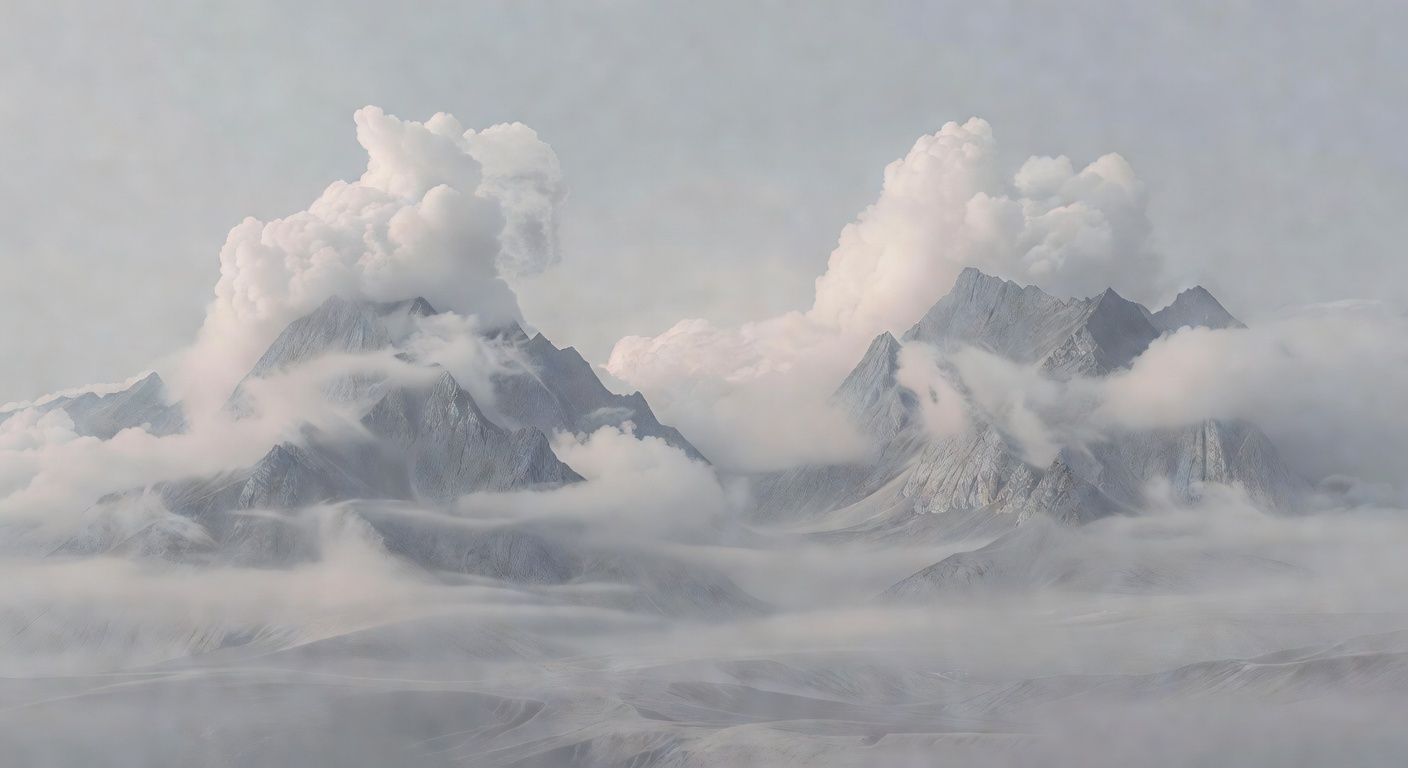
In Japan, mountains are not merely geological formations. They are living presences — places where the boundary between the human and the sacred grows permeable, where climbers come not only to reach a summit but to encounter something of themselves they could not find in the valley below.
On a clear winter morning, Mount Fuji appears as if painted directly onto the sky — its cone so perfect, its presence so absolute, that it seems less like a mountain and more like a statement. For centuries, artists, poets, and pilgrims have made their way toward it. Katsushika Hokusai depicted it 36 times. Bashō wrote of its hidden face behind clouds. Millions visit every year.
And yet, for the Japanese, the significance of mountains extends far beyond the iconic slopes of Fuji. From the Dewa Sanzan in Yamagata prefecture to the Kii mountain range, Japan's landscape is scattered with peaks considered sacred — shintai, or "divine bodies," in the Shinto tradition.
The Mountain as Sacred Body
In Shinto cosmology, kami — spiritual forces or presences — are understood to inhabit natural phenomena: rivers, stones, forests, and above all, mountains. A mountain is not a place where a god lives; it is the god, or at least the form through which the god makes itself known in the world.
To climb a mountain in Japan is not to conquer it. It is to enter a conversation you are not sure you are qualified to join.
— Kenji Shimizu, Polymer Recycling Plant
The three mountains of Dewa — Haguro-san, Gas-san, and Yudono-san — form a pilgrimage circuit that symbolises the three stages of life: birth, death, and rebirth. Pilgrims dressed in white shugendō robes have traversed these peaks for more than 1,400 years. The practice is still alive today, undertaken each summer by thousands who climb not for fitness or tourism but for transformation.
Shinrin-yoku: The Forest Bath
In recent decades, a related Japanese concept has gained global traction: shinrin-yoku (森林浴), or "forest bathing." The practice — simply spending mindful time in forested areas — was formalised by the Japanese Ministry of Agriculture, Forestry and Fisheries in 1982 and has since been the subject of significant medical research.
Studies conducted by environmental health researcher Yoshifumi Miyazaki at Chiba University found that walking in forests, as opposed to urban environments, measurably reduces cortisol levels, lowers blood pressure, and suppresses sympathetic nervous system activity. The mountain forest, in this sense, is not only a spiritual environment but a biological one — the body responds to it in ways that no urban park quite replicates.

The paper crane — like the mountain — is a symbol of transformation. Japanese tradition holds that folding 1,000 cranes brings a wish to life.
What the Ascent Teaches
There is a particular quality to the attention demanded by a mountain path. The trail requires you to be precisely where you are — to watch the placement of your feet, to read the weather in the changing light, to notice when your breath shortens and your legs grow heavy. The mind's habitual tendency toward abstraction — toward planning, regretting, calculating — is interrupted by the immediate and undeniable fact of the terrain.
This is perhaps why so many Japanese thinkers, from Zen monks to contemporary philosophers, have found mountains not merely scenic but instructive. The mountain does not tell you who to be or what to think. It simply insists that you be fully present — which, as any serious practitioner of zazen or shodō will tell you, is already a significant achievement.
Contemporary Mountain Culture
Japan's relationship with mountains continues to evolve. The recent resurgence of interest in yama-girl culture — young women hiking in colourful, fashionable outdoor gear — has brought a new demographic to the trails. Mountain huts (yamagoya) report growing bookings from first-time hikers seeking both adventure and quiet. Guided pilgrimages to lesser-known sacred peaks are increasingly popular with urban professionals seeking something the city cannot offer.
None of this diminishes the depth of what Japan's mountains represent. If anything, it suggests that the need for what they offer — presence, humility, a perspective wider than the individual self — is as urgent as ever.